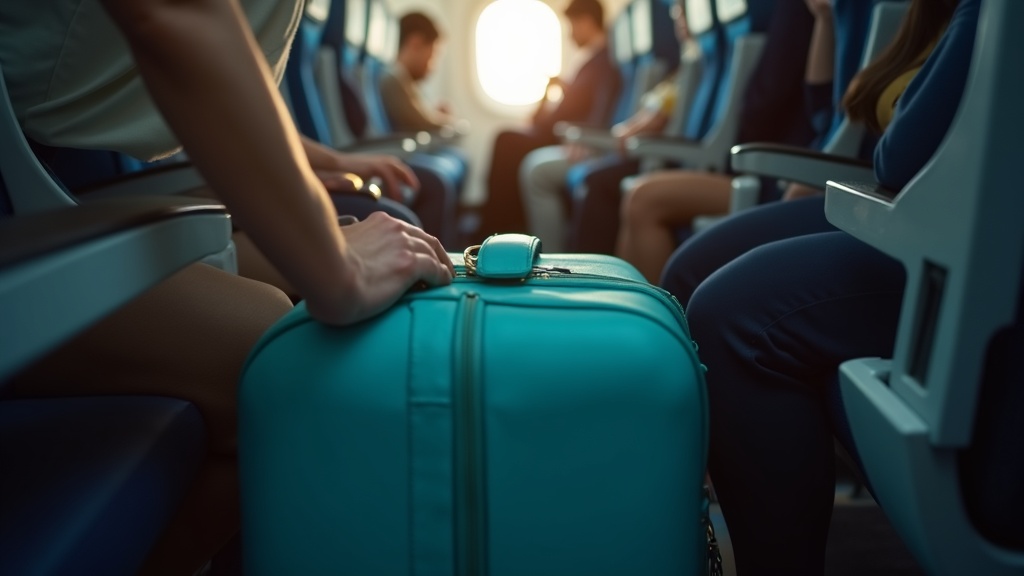
You’re standing at the gate, boarding pass in hand, when the airline agent stops you. Your bag looks too big. Maybe it needs to be checked. That’ll be fifty dollars, please.
This nightmare scenario plays out every day at airports around the world, and it’s usually completely avoidable. The problem isn’t that travelers are trying to sneak oversized bags onto planes. Most people genuinely don’t know what counts as a personal item or whether their bag will actually fit under the seat in front of them.
Airlines don’t make this easy. Each carrier has different size limits, and those limits don’t always match the real-world space under airplane seats. Your bag might meet the official measurements but still not squeeze into place. Or it might look too big but fit perfectly fine.
The good news? Once you understand how underseat space actually works and what airlines are really looking for, you can pack with confidence. You’ll know exactly which bags work, how to measure them properly, and what to expect when you board.
This guide will walk you through everything you need to know about personal item size for flights. No more guessing. No more gate-check anxiety. Just straightforward answers that help you breeze through boarding without surprise fees or last-minute stress.
Under the seat space is smaller than most people expect
If you’ve never measured the space under an airplane seat, you might be in for a surprise. That area is significantly smaller than most people imagine, and it’s rarely a simple rectangle.
The actual usable space depends on which plane you’re on and where you’re sitting. Some aircraft have metal boxes under the seats that house entertainment systems or electrical equipment. Others have support bars that angle across the floor. The seat itself usually slopes backward, which means the opening at floor level is wider than the space a few inches up where your bag actually sits.
Here’s where it gets tricky. An airline might say your personal item can be 18 inches long, but that doesn’t mean an 18-inch bag will slide neatly under every seat. The posted dimensions are maximums, not guarantees. A bag that technically meets the requirements might still stick out into the footwell or refuse to fit at all, depending on the seat.
Your seat location matters more than you’d think. Window seats often have the curved wall of the plane cutting into the space. Bulkhead seats, the ones right behind a wall or divider, usually have no underseat storage at all because there’s no seat in front of you. Some exit row seats have similar restrictions. Even aisle and middle seats can vary depending on how the brackets and supports are positioned.
The reality is that a bag fitting comfortably under the seat means it slides in without force, doesn’t bulge out, and leaves you enough room to stretch your feet. That’s a smaller target than the numbers on the airline’s website might suggest.
Shape and structure matter as much as dimensions
A bag that measures 18 by 14 by 8 inches on paper can fit very differently in real life depending on what it’s made of. Soft-sided bags made from fabric or nylon have what travelers call a “squish factor.” They compress and mold themselves into the underseat space, even if that space is oddly shaped or slightly smaller than expected.
Hard-shell bags and heavily structured luggage don’t have that flexibility. They take up every inch of their measured size, and sometimes more. If your bag has rigid corners, a stiff frame, or a hard plastic shell, it won’t squeeze down when the underseat area turns out to be narrower than you hoped.
Wheels add bulk in ways that dimension tags don’t always capture. A bag might technically fit the size limits, but if it has chunky wheels on the bottom, those wheels eat into the available space under the seat. The same goes for overstuffed exterior pockets. You might pack your main compartment perfectly, but then jam the front pocket so full that the whole bag balloons outward.
Think of it this way: a slightly smaller bag that can compress will almost always cause you less stress than a bag that maxes out the size limit but has no give. Flight attendants don’t measure bags with a ruler. They watch whether it slides under the seat without a fight. A flexible bag that’s an inch smaller often wins that test over a rigid one that’s technically allowed but won’t bend.
Common personal items that usually fit and ones that often don’t
Most people sail through with a small backpack, the kind you’d use for a day trip or commute. These usually fit because they’re soft and compress nicely when you slide them under the seat. Same goes for slim laptop bags, basic tote bags that aren’t stuffed to bursting, and those flat messenger bags office workers carry. The key is that they’re flexible and relatively flat.
A small duffle bag works too, as long as you haven’t packed it like you’re moving apartments. The softer the sides, the easier it squishes into that awkward space under the seat in front of you.
Now for the troublemakers. That big school backpack you’ve been using since college? If it’s packed full, it’s probably too tall and too rigid to fit properly. Rolling briefcases seem convenient until you realize they don’t bend, and that hard shell takes up way more room than you’d think. Bulky gym bags rarely cooperate, especially the barrel-shaped ones.
Overstuffed tote bags cause problems too. Sure, a tote usually fits, but when you’ve crammed it full of shoes, books, and snacks, it becomes a rigid brick that won’t slide anywhere. Boxy camera bags follow the same logic. The hard structure protects your gear but makes fitting under a seat nearly impossible.
Here’s the thing that matters most: whether something fits depends less on what type of bag it is and more on how full you’ve packed it and whether it has any give to it. A backpack that’s half-empty will squeeze under just fine. That same backpack stuffed until the zippers strain won’t budge. The bag should slide fully underneath without you having to force it or sit with your knees up by your chin.
Simple ways to test your bag before you get to the gate
The best time to find out your bag won’t fit is at home, not while boarding. Start by packing your bag exactly the way you plan to travel. Don’t measure it empty. Stuff it with your actual trip items, then check the dimensions at its bulkiest points.
Most airlines list their personal item limits on their website, usually something like sixteen by fourteen by twelve inches. Grab a tape measure and check your packed bag’s length, width, and height. If you’re within an inch or two, you’re probably fine. If you’re pushing it, keep reading.
Here’s a simple home test that works surprisingly well. Slide your packed bag under a dining chair or coffee table. If it fits comfortably underneath without forcing it, you’re in good shape. Airplane seat clearances vary, but this gives you a realistic sense of whether your bag will actually slide under without a fight.
Pay attention to whether your bag compresses. Soft duffel-style bags and backpacks usually squish down when needed. Hard-sided bags and overstuffed totes don’t give at all, so what you measure is what you get.
If you’re borderline, have a backup plan for the airport. Wear your bulkiest jacket instead of packing it. Move your water bottle, snacks, or book to your coat pockets before boarding. If you’re traveling with someone, shift one or two rigid items like a tablet or shoes into their bag. These small adjustments can make the difference between breezing onto the plane and facing an awkward conversation at the gate.