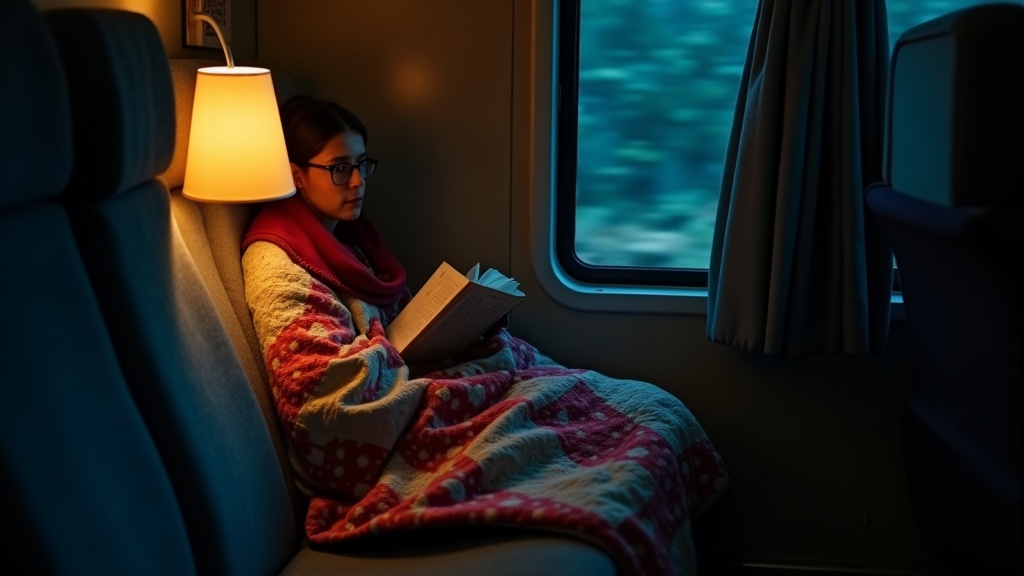
There’s something nobody tells you before your first overnight train journey: you’re probably going to wake up cold. Not freezing exactly, but that uncomfortable kind of chilly that makes you curl up tighter and wish you’d brought another layer.
It happens to almost everyone, even experienced travelers. You board the train feeling fine, maybe even a bit warm from hauling your luggage down the platform. The compartment seems comfortable enough. Then somewhere around three in the morning, you wake up wishing you had a proper blanket.
The thing is, trains at night get colder than you’d expect. The air conditioning runs stronger than it needs to. The heating doesn’t always work well. And even when the temperature is technically reasonable, something about sleeping while moving through the night air makes your body feel colder than usual.
Here’s the good news: staying warm on an overnight train isn’t complicated or expensive. It’s mostly about knowing what to expect and making a few simple choices before you board. We’re talking about things like what to pack in your day bag, which seat or berth to choose if you get the option, and how to layer your clothing so you can adjust as the temperature shifts.
You don’t need special gear or a huge budget. You just need to think ahead a little differently than you would for a hotel. Because unlike a hotel room, you can’t just reach over and adjust the thermostat when you get cold at midnight.
Why overnight trains can feel cold even when it’s not that cold outside
Trains have a talent for feeling colder than they should. Part of this comes down to air conditioning that runs stronger than you’d expect, especially on newer trains. The system is trying to keep hundreds of people comfortable in a sealed metal tube, so it tends to err on the side of cool rather than warm.
Then there’s the matter of air vents. Many are positioned right above seats or bunks, creating a steady stream of cold air aimed directly at you while you’re trying to sleep. You might not notice it much when you’re awake and moving around, but lying still under a vent for hours is a different story.
Every time the train stops at a station, doors open and close. Cold air rushes in, warm air escapes, and the whole car resets to a lower temperature. This happens over and over through the night, especially on routes with frequent stops.
Windows are another culprit. Even when they’re sealed shut, older trains often have gaps that let in drafts. Sitting or sleeping near a window can mean dealing with a surprising amount of cold air seeping through, especially if the train is moving fast.
Your own body works against you too. When you’re sitting or lying still for hours, your circulation slows down and you generate less heat. Add in the fact that you’re probably trying to relax or sleep, and your body temperature naturally dips a bit.
Here’s the tricky part: different sections of the same train can feel completely different. The car near the engine might be warm while the last car is freezing. Upper bunks often feel stuffier, lower ones draftier. There’s no universal setting that works everywhere at once.
Dress for sleep, not for the station
Here’s the trap most people fall into: you dress for the platform, the waiting area, maybe the walk to the station. Then once you’re settled in your seat or sleeper, the train gets cold and you’re stuck in a thin shirt wondering why you packed your sweater at the bottom of your bag.
Think about what you’ll be wearing at three in the morning, not what looks reasonable when you board. You want to be warm enough to sleep without needing to dig through luggage in the dark or wrestle into extra layers in a space the size of a closet.
The simplest approach is three layers that work together. Start with a comfortable base layer, something soft against your skin that you could actually sleep in. Add a warm middle layer like a fleece or soft sweater. Then top it off with one easy-to-remove outer layer in case the carriage is warm when you first get on.
Skip anything with tight waistbands, stiff zippers against your neck, or scratchy fabric. You’re trying to sleep, not endure discomfort for eight hours. Elastic waistbands and soft materials are your friends here.
Two quick wins make a real difference. Warm socks are worth their weight in gold because cold feet will keep you awake even if the rest of you is fine. And if you’re someone who loses heat from your head, bring a light beanie or wear something with a hood. You can always take it off, but you’ll be glad it’s there when the heating cuts out somewhere past midnight.
The goal is to be slightly too warm when you board. You can always shed a layer, but adding warmth later means fumbling in the dark with luggage you’ve carefully stowed away.
Use a blanket strategy that fits in limited luggage space
Train companies sometimes provide blankets, but they’re often thin and sized more for your legs than your whole body. If you’re traveling in shoulder season or through mountain routes, that flimsy square of fabric won’t be enough when the heating cuts out at 3 a.m.
A compact travel blanket solves this without eating up your suitcase. Look for ones that fold into their own pouch about the size of a water bottle. These usually give you enough coverage to wrap around your shoulders and torso, which matters more than covering your feet. Your core generates most of your body heat, so keeping your chest and back insulated makes a bigger difference than you’d expect.
If you don’t want to buy another item, a large scarf works surprisingly well as a second layer. Wrap it around your neck and shoulders, or drape it across your chest under the train blanket. During the day, you wear it normally. At night, it’s extra insulation exactly where you need it.
Your extra jacket can also double as a blanket. Lay it across your chest and tuck the arms around your sides. It stays in place better than a loose blanket when you shift around trying to get comfortable.
Here’s the trick to keeping any blanket from sliding off: tuck one edge under your hip or thigh when you settle in. This anchors it even when you move. If you’re using the train blanket plus your own layer, put the heavier one on top. The weight helps both layers stay put, and you get the most warmth closest to your body where it counts.
Block drafts and choose a warmer spot when you can
The coldest spots on overnight trains aren’t random. They follow predictable patterns, and once you know what to look for, you can avoid the worst of them.
Doors between train cars are draft magnets. Every time someone passes through, cold air rushes in, and even when they’re closed, the seals are rarely perfect. If your seat is within a few rows of these doors, you’ll feel every gust. The same goes for windows with visible gaps or worn seals. Run your hand along the edge if you’re not sure. You’ll feel the cold air leaking through.
Overhead vents are another common culprit. Some blow cold air directly down, and if you’re sitting right under one, you’ll be fighting a losing battle all night. Look up and check before you settle in.
Seats against exterior walls can feel noticeably colder than others, especially in winter. The metal or thin paneling conducts cold from outside, and you’ll feel it through your clothes if you lean back.
If you have any flexibility in where you sit, aim for the middle of the car, away from doors and exterior walls. Even moving one or two seats over can make a real difference.
When you can’t change seats, make small adjustments. Angle yourself away from a drafty window. Drape a scarf or jacket over your neck and shoulders to block air from sliding down your collar. Tuck a spare layer between your back and a cold wall. If the overhead vent has an adjustable nozzle, point it away from you.
These aren’t dramatic fixes, but they add up. A little attention to your immediate environment goes a long way toward staying warm.
Set up your sleep to stay warm through the coldest hours
Here’s the thing about sleeping on trains: you feel fine when you drift off, then wake up shivering at three in the morning wondering what happened. Your body temperature naturally drops while you sleep, and trains get coldest in those pre-dawn hours when the heating system is working its least and everyone else is asleep.
The trick is to layer up before you get drowsy, not after you wake up cold. Put on that extra sweater or hoodie while you’re still awake and functional. Keep your socks on, even if you normally sleep without them at home. Your feet lose heat quickly, and cold feet have a way of making your whole body feel miserable.
Tuck your blanket or jacket carefully around your shoulders and feet before you settle in. These are the spots where warmth escapes most easily, and you won’t notice the drafts until you’re already cold. If you’re using a travel blanket, wrap it snug rather than draping it loosely.
Keep a spare layer within arm’s reach. Tuck a cardigan or scarf into the seat pocket, or wedge it between your body and the wall. The goal is to grab something warm without fully waking up or fumbling through your bag in the dark. If your extra clothes are buried in the overhead luggage, you probably won’t bother getting them when you need them most.
Think of it as a little warmth kit: one item you can pull on half-asleep, no digging required. Your three-in-the-morning self will thank you for thinking ahead.