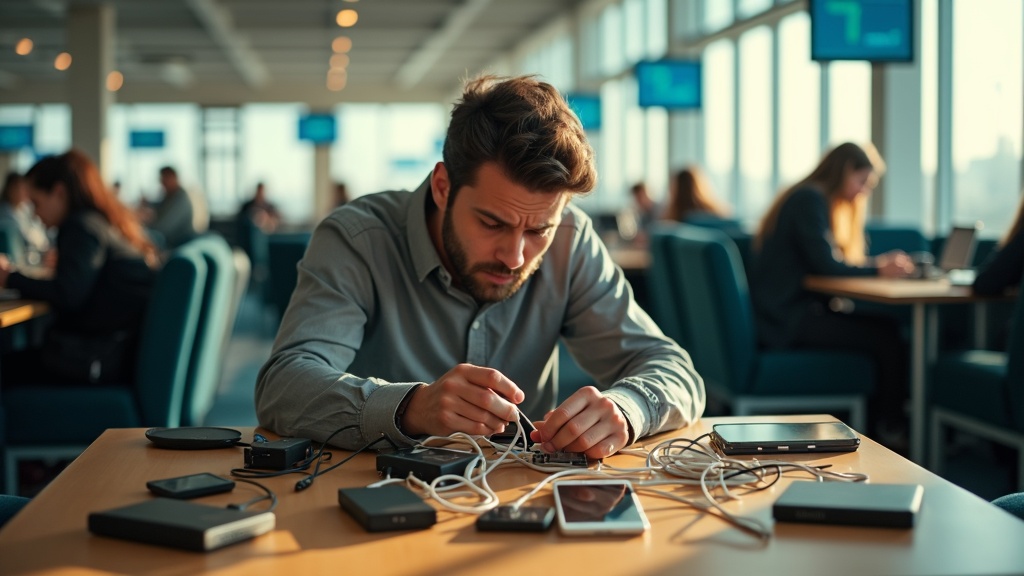
You’re standing in front of a museum you’ve been dying to visit, and your phone is dead. Your power bank? It ran out two hours ago after barely charging anything. Or maybe it’s sitting back at the hotel because it was too heavy to carry all day. Either way, you’re now navigating a foreign city with a dark screen and no way to call your ride.
This happens more often than you’d think. Most travelers grab a power bank based on one number: how many milliamp hours it promises. Bigger sounds better, right? But that 30,000mAh brick might be too heavy to actually bring with you, or it might not even make it through airport security.
The truth is, selecting a travel power bank isn’t about finding the biggest battery. It’s about matching the right size and features to how you actually travel. A power bank that stays in your bag because it’s inconvenient is worse than a smaller one you’ll actually use.
The wrong choice doesn’t just mean a dead phone. It means missed connections, lost reservations, and that nagging anxiety of being unreachable. It means choosing between lugging extra weight all day or gambling that your battery will last.
The good news? Once you understand a few practical details beyond raw capacity, picking the right power bank becomes straightforward. You’ll know exactly what works for a day of sightseeing versus a week camping off-grid, and what features actually matter when you’re charging devices on the go.
Start with what you need to charge and how often
Before you look at power bank specs, pull out your phone and actually list what you’ll be traveling with. Write it down. Your phone, sure. But also your wireless earbuds, your Kindle or tablet, maybe a camera or a handheld gaming console. Some people bring a laptop. Each device you add changes what you need.
Now think about your typical day on the trip. Are you out sightseeing from breakfast until dinner with no chance to plug in? That’s different from hopping between cafés and hotels where outlets are easy to find. If you’re doing a single long day exploring a city, you might just need one extra phone charge to feel safe. But if you’re on a multi-day hike or a road trip through areas with sketchy power access, you need enough juice to top up several devices over a couple of days.
Here’s what enough power actually feels like in practice. For most people doing normal travel, a power bank that can charge your phone twice is plenty. You charge the bank at night, use it during the day if needed, repeat. If you’re carrying a tablet and a camera too, you want something that can handle all three without running dry halfway through your second day.
One thing that changes everything: whether you’ll have regular access to a wall outlet. If you’re checking into hotels every night, you can recharge your power bank while you sleep. That means you can get away with a smaller, lighter pack. But if outlets are rare or unreliable, size up. The last thing you want is to ration battery power like it’s the apocalypse.
Understand capacity claims without getting misled
You see a power bank labeled 20,000mAh and assume it’ll charge your 3,000mAh phone about six or seven times. That math makes sense on paper. But in reality, you’ll be lucky to get four full charges, maybe five if conditions are perfect.
The number printed on the box represents the total energy stored inside the power bank’s battery cells. But your phone never receives all of that energy. Some gets lost as heat during the conversion process. More disappears because the power bank has to boost its internal voltage to match what your phone expects through the charging cable.
Think of it like buying a gallon of paint. The can says one gallon, but after you account for what sticks to the brush, drips on the floor, and stays in the can, you’re actually painting with maybe three-quarters of a gallon. The loss is just part of how the process works.
A reasonable rule of thumb is to expect about 60 to 70 percent of the advertised capacity to reach your devices. So that 20,000mAh power bank effectively delivers somewhere around 12,000 to 14,000mAh of usable charge. That’s still helpful, but it changes your expectations.
This isn’t about companies lying to you. The capacity number reflects what’s technically inside. But if you’re selecting a travel power bank based purely on that big number, you might pack too small and run out of juice halfway through your trip. Always mentally adjust downward when you’re planning how many charges you’ll actually get.
Check airline rules early to avoid losing your power bank
Here’s something that catches a lot of travelers off guard: airlines care a lot about the power banks you bring on board. And if yours doesn’t meet their rules, you might have to hand it over at security or miss your flight while you scramble for a solution.
Power banks have to go in your carry-on bag, not your checked luggage. That’s because lithium batteries can overheat, and if something goes wrong, the crew needs to deal with it quickly. Burying one in the cargo hold is a safety issue.
Airlines set limits based on something called watt-hours, usually written as “Wh” on the power bank’s label or packaging. This number tells you how much energy the battery stores. The problem is that many power banks don’t display this clearly, or they only show milliamp-hours, which is a different measurement.
If your power bank doesn’t have a visible Wh rating, airport security might not let it through. Some travelers have been forced to throw away a brand-new charger because they couldn’t prove it met the airline’s requirements. Others have had to leave the line, repack their bags, or even abandon the device entirely.
Before you buy, check the product label or description for a clearly marked watt-hour rating. If it’s not there, look for the milliamp-hours and voltage so you can calculate it yourself, or just pick a different model that’s upfront about the specs.
It’s also smart to check your airline’s policy a few days before you fly. Rules vary between carriers and routes, and what works on one trip might not fly on another. Keep any documentation or the original box handy when you travel, just in case someone at security asks questions.
Match ports and charging speed to your devices
The ports on your power bank need to actually work with what you carry. Older power banks often have only USB-A ports, the rectangular ones you’ve been plugging things into for years. Most newer phones, tablets, and even earbuds now use USB-C, the smaller oval port that works either way up. If your power bank only has USB-A, you’ll need to carry extra cables or adapters, which is exactly the kind of hassle you don’t want when you’re rushing through an airport.
USB-C isn’t just a different shape. It can deliver more power, which means faster charging when your devices support it. A phone that takes two hours to charge from a low-power USB-A port might fill up in under an hour from a proper USB-C output. That difference matters when you’ve got thirty minutes between flights and your phone is at twelve percent.
Check the output power listed on the power bank. You’ll see numbers like ten watts, eighteen watts, or thirty watts. Higher numbers mean faster charging, but only if your device can accept it. Most phones charge well at eighteen to twenty watts. Tablets often want more. Some lightweight laptops can charge from a power bank, but they usually need at least thirty watts, and many need more.
If you travel with multiple devices, look for a power bank with at least two ports. Just know that charging two things at once usually slows everything down, since the battery splits its power between them.
One last feature worth mentioning is pass-through charging. This lets you charge the power bank itself while it’s charging your phone. Not essential, but handy if you only have one outlet in your hotel room and want everything topped up by morning.
Pick a size and weight you will actually carry
A power bank sitting in your hotel room does you absolutely no good. Yet this happens all the time because people buy based on capacity numbers without thinking about whether they’ll actually want to haul that thing around all day.
Here’s the trade-off: more battery capacity means more weight and bulk. A compact power bank that slips into your jacket pocket might only charge your phone once. A hefty brick that can recharge your phone four times might weigh as much as a paperback book and feel like carrying around a deck of cards made of lead.
Think about how you’ll actually use it during your trip. If you’re exploring a city on foot all day with just a small crossbody bag, you want something thin and light that won’t throw off your balance or dig into your side. Long and slim designs work better in day bags and pockets than thick square blocks.
Planning to hike or do outdoor activities? You probably can’t spare the weight or space for a massive charger. Business travelers with a laptop bag have more room to work with, but even then, a chunky power bank takes up valuable carry-on space.
Pay attention to where the charging ports sit on the device. If they’re on the narrow end, you can tuck the power bank into a bag pocket and run a cable out without the whole thing flopping around. Ports on the broad side make it awkward to charge while the pack is stored away.
The best capacity is the one you’ll consistently bring with you. A moderately sized power bank in your bag beats a high-capacity monster gathering dust in your luggage every single time.