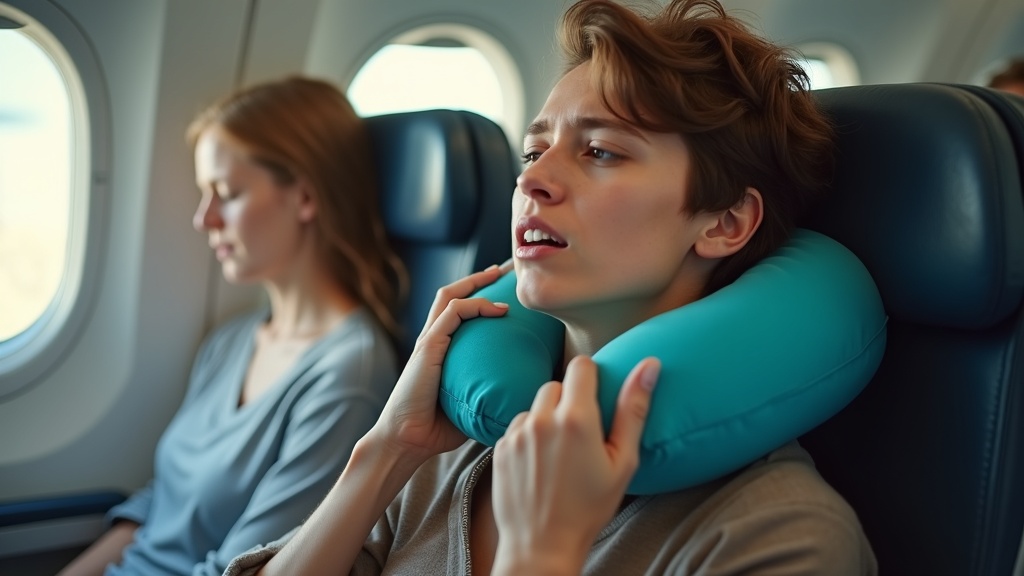
You’re settled into your seat, ready for a long flight or car ride. You wrap your neck pillow around your neck, close your eyes, and five minutes later it’s sliding off to the side. Or bunching up behind your head. Or doing absolutely nothing useful at all.
If this sounds familiar, you’re not alone. And here’s the thing: you’re probably not doing anything wrong.
Most neck pillows are designed with a sort of average person in mind. But necks come in different lengths, heads sit at different angles, and airplane seats definitely aren’t all the same. What works perfectly for one person can feel completely useless for someone else.
The good news is that a slipping neck pillow is usually a fit problem, not a pillow problem. It’s about how the pillow sits against your specific neck shape, how you’re positioned in your seat, and sometimes just how the pillow is oriented in the first place.
You don’t necessarily need to throw out your travel pillow and buy an expensive replacement. Often, a few simple adjustments to how you’re using it can make all the difference. Small changes to positioning, a tweak to how tight it sits, or even just understanding why it keeps sliding can help you finally get the neck support you’ve been hoping for.
Why neck pillows slip in the first place
The main problem is simple: most travel pillows are made in one or two standard sizes, but necks and shoulders come in every shape imaginable. A pillow that fits snugly on someone with narrow shoulders might barely touch the neck of someone broader. That mismatch creates gaps, and gaps mean slipping.
When you lean back in your seat, your head doesn’t usually rest straight against the pillow. Instead, it tends to tilt or roll to one side. If the pillow isn’t gripping your neck firmly, gravity does its thing and the whole cushion starts sliding down or rotating around your shoulders.
Fabric plays a bigger role than you’d think. Many neck pillows have smooth synthetic covers that glide easily over jacket material, hoodies, or even just clean hair. Add in the vibration of a plane or train, and that slippery surface keeps nudging the pillow out of place bit by bit.
The angle of airplane seats makes things worse. Most seats recline just enough to leave your head hovering awkwardly between upright and relaxed. Your neck wants to fall forward, not back, so the pillow ends up supporting nothing but air while your chin drops toward your chest.
There’s also the issue of the gap behind your neck. Standard U-shaped pillows wrap around the sides, but they often leave a hollow space at the back where your neck actually needs support. Without something filling that gap, the pillow has room to shift and twist every time you move.
Adjust the way you wear it, not the pillow
Before you start hunting for fixes or buying anything new, try changing how you position the pillow itself. Most people put it on the same way every time without thinking about it, but a small shift in placement can make a huge difference.
The standard U-shape has an opening, and where that opening sits matters more than you’d think. If your head tends to drop forward when you sleep, try rotating the pillow so the thicker, cushioned part supports your chin instead of the back of your neck. This gives your head somewhere to rest without sliding down.
On the other hand, if you lean to one side or the other, wear the opening at the back of your neck. This puts the bulk of the pillow on your shoulders where you actually need the support.
Height makes a difference too. Most people wear their neck pillow too low, letting it settle on their shoulders like a scarf. Try pulling it higher so it hugs just under your jaw. This keeps your head from bobbing around and reduces the chance of the pillow creeping downward.
If you’re wearing a hoodie or a scarf, use it. Pull your hoodie collar up slightly or wrap your scarf so it sits just below the pillow. These layers create a bit of friction that keeps everything in place without any effort. It’s not about adding something new, just working with what you’re already wearing.
The key is to experiment a little before your trip. What works for someone else might not work for you, and that’s completely normal.
Make the closure do real work
Most travel pillows come with some kind of fastener at the front. A snap button, a toggle cord, or a simple strap with Velcro. The problem is that most of us fasten it once and forget about it, treating it like a decorative touch rather than an actual tool.
That closure is there to control how tightly the pillow hugs your neck. When you fasten it loosely, the two ends stay far apart and the whole thing gapes open. This creates space for the pillow to slide around, especially when you lean your head to one side or shift position.
Try fastening it snugly instead. Pull the ends closer together before you snap or toggle them shut. You want to feel gentle contact on both sides of your neck, not pressure, just presence. The pillow should feel like it’s lightly wrapped around you, not just resting there.
If your pillow keeps riding down toward your shoulders, the closure might be sitting too low. Shift it slightly off-center or higher up before you fasten it. This helps anchor the pillow closer to the base of your skull where it actually supports your head.
The key is to adjust before you settle in. Once you’re comfortable and half asleep, you won’t want to fiddle with it. Spend thirty seconds getting the tension right while you’re still alert. Close it firmly enough that the pillow stays put when you move your head side to side. If it still feels loose, open it and try again with the ends pulled tighter together. That simple adjustment makes a surprising difference.
Add friction so it stops sliding on fabric
Most neck pillow slipping happens because two smooth surfaces are rubbing against each other. Your pillow cover glides right over your rain jacket, windbreaker, or even freshly washed hair. It’s basically physics working against your comfort.
The simplest fix is to add a layer with some grip between your pillow and whatever you’re wearing. If you’ve got a hoodie on, pull the hood up before putting your neck pillow in place. That fabric barrier creates friction and keeps everything locked together much better than a slick nylon jacket would.
A lightweight scarf works the same way. Drape it around your neck first, then position your travel pillow over it. The scarf acts like a non-slip mat between your skin or clothing and the pillow. Even a thin cotton scarf makes a noticeable difference.
If you’re wearing a smooth jacket and don’t want to change, try putting on a knit sweater or cardigan as your top layer instead. Textured fabrics like wool, fleece, or thick cotton naturally grip better than technical fabrics designed to be water-resistant.
Here’s a trick many travelers miss: flip your pillow cover inside out or check if it has two different textures. Some covers have a slightly rubberized or textured side that grips better. If yours does, make sure that side faces your clothing.
The key is creating friction without making yourself uncomfortable or using anything sticky or permanent. You want something that holds the pillow steady but still lets you adjust when you shift positions during the flight.
Stop the gap behind your neck
Here’s what usually happens: you settle into your seat with your neck pillow on, lean back, and the whole thing slides forward. Or your head tips backward and the pillow creeps up. The problem isn’t always the pillow itself. It’s the empty space between your neck and the seat.
Most airplane and car seats push the pillow forward at shoulder level while leaving a gap right where your neck curves. Your head and the pillow end up floating in that hollow, free to drift around every time you shift or doze off.
The simplest fix is to close that gap. If your seat has adjustable wings on the headrest, angle them forward so they cradle your head without squashing the pillow. This keeps everything in place without any extra effort.
If the headrest isn’t adjustable, try sitting slightly forward so the seat back isn’t compressing the pillow from behind. You don’t need to sit bolt upright. Just an inch or two can make a difference.
Another easy trick: fold a jacket or sweater and tuck it behind your upper back. This brings your whole torso forward just enough that your neck sits closer to the headrest. The gap shrinks, and your pillow has less room to wander.
For a more targeted approach, roll up a small scarf or soft layer and place it right at neck height behind the pillow. It fills the hollow and gives the pillow something to rest against. You’re not building a fortress here. Just a little padding in the right spot keeps everything stable without adding bulk or requiring gear you don’t already have with you.